
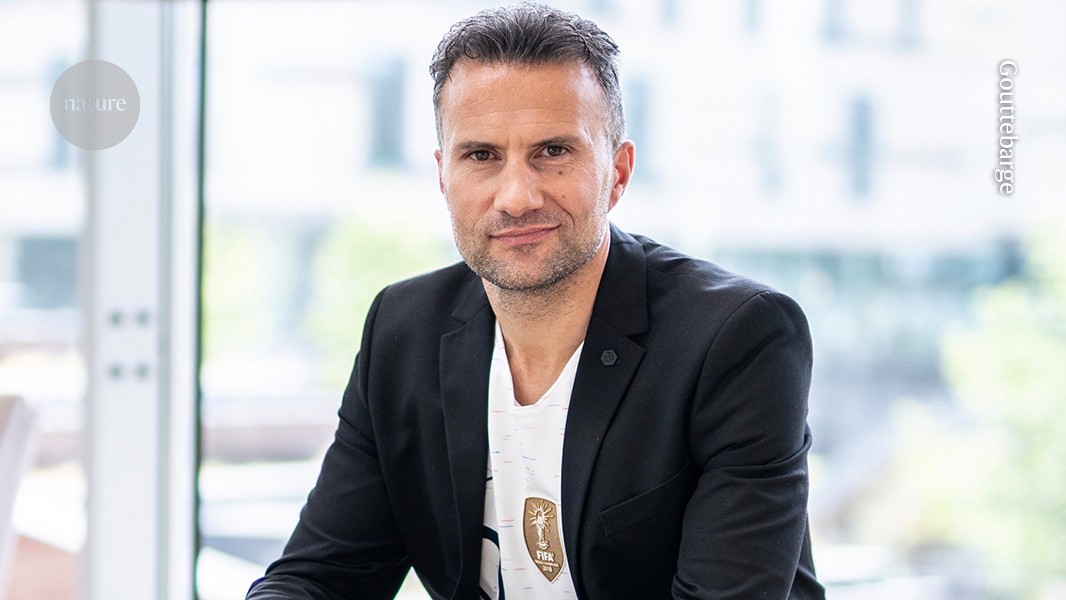
Vincent Gouttebarge played professional football in France and the Netherlands for more than a decade before retiring in 2007 and concentrating on a medical-research career. Familiar with injury during his sporting days, he now works as medical director at the International Federation of Professional Footballers (FIFPRO), which is a players’ union, and as chair of the International Olympic Committee’s Mental Health Working Group, alongside his research at the University of Pretoria and Amsterdam University Medical Centre.
As the 2026 men’s football World Cup starts in the United States, Canada and Mexico, he spoke to Nature about what the game’s biggest tournament means for the physical and mental health of the players who compete in it.
Can the ‘steroid Olympics’ show the sporting community how to support athletes better?
What do you understand from the inside about the health of footballers that is hard to see from the outside?
Footballers are not superheroes — they can be exposed to many health conditions. Musculoskeletal injury is well known, but symptoms of mental-health issues are also prevalent. That is why I chose, years after retiring, to look at the mental-health challenges for players both during and after a career in professional football.
The World Cup is about to begin. What does it do to players’ mental health?
Being selected for a national team and competing at a World Cup is obviously positive. But it depends very much on how the competition goes — whether the person is playing or on the bench, whether the team is winning. You also need to look beyond the competition itself. After the World Cup, players need to be back at their clubs very quickly. If they are lucky, they have one or two weeks off. For many, even that is not feasible. There is no recovery period between two seasons.
Is this tight schedule a health problem, not just a performance one?
Yes. The match calendar — all the domestic and international competitions — puts a huge burden on the players, not only physically and physiologically, but also emotionally and cognitively.
At the elite level, players are sometimes exposed to two or three games a week, back-to-back, with no day off. In 2024, together with the World Leagues, FIFPRO called on the International Federation of Association Football (FIFA) to reschedule tournaments to give players more recovery time between major competitions.
And this is even without talking about the social-media pressure that is now present every day, during the season as well as during holidays.
How common are mental-health issues in professional football, and what causes them?
What we measure are symptoms: self-reported adverse thoughts, feelings and behaviours. Clinically diagnosing specific disorders for research purposes is not feasible in elite sport because the process is too time-consuming. But from the epidemiological studies I have been conducting since 2012 in professional football and across elite sport, clear patterns can be seen.
There are generic stressors that are relevant to the general population — professional footballers have a social life and relationships outside the sport, and they experience the same adverse events as anyone else. But these combine with sport-specific contributing factors. Injury is a major one. Researchers have good evidence for a bidirectional relationship between injury and mental health: poor mental health can predispose an athlete to musculoskeletal injury. And a severe injury that means a long period without training or competition is the most significant adverse life event in an athlete’s career. Unexpected poor performance is another factor.
Is there still stigma around mental health in professional football?
The stigma is relevant across the general population in many countries, and it is present in football, which is by tradition a conservative sport. I think in Europe we are well on the way to breaking the stigma, but there is still a lot of work to do.
If you look at other continents where football is very popular — South America, Africa, parts of Asia — it is still seen as a weakness to speak about mental health.
If a player has an ankle injury or a hamstring problem, they speak openly about it at press conferences. But when it comes to depression or anxiety, we are still not there. Players are worried about the reaction of their coach. They fear that if a coach knows they have experienced depression, they will not put them in the starting eleven.
I think we need both a bottom-up approach — mental-health literacy programmes and education for players and coaches, for example — and a top-down approach. At national-federation level, medical committees are conventionally composed of sports-medicine physicians, orthopaedic surgeons and cardiologists. But they don’t usually have a mental-health professional. That needs to change.
You worked to increase mental-health awareness in professional football. Did it succeed?
We developed a programme at FIFPRO in 2018 to educate players. We found that attitudes and behaviour were better after the programme than before. It was not a randomized controlled trial, but it was at least a small piece of evidence that if you invest a little time in mental-health literacy, explaining why mental-health challenges should be on the same level on the agenda as musculoskeletal injury, then you can have real benefits.
The Enhanced Games miss the point: science can clean up sport
What do you think of the practice of asking players who are out of favour to train separately?
It is something I feel very strongly about. We see it a lot in professional football: a new coach arrives, the squad is too large, and certain players are asked to train alone or with the youth team. From a trade-union perspective, this is bad behaviour, because those players have signed contracts with their employer. But it is also a mental-health issue: social support is protective, and deliberately isolating a player from their workplace environment increases their mental-health risks. It would not be acceptable in any other industry, but in professional football, it still happens regularly because of poor leadership at club level.
Enjoying our latest content?
Log in or create an account to continue
- Access the most recent journalism from Nature's award-winning team
- Explore the latest features & opinion covering groundbreaking research
Nature 654, 597-598 (2026)
doi: https://doi.org/10.1038/d41586-026-01865-2
This interview has been edited for length and clarity.
Competing Interests
The author declares no competing interests.
Related Articles
Subjects
- Society
- Health care
- Human behaviour
Latest on:
- Society
- Health care
- Human behaviour
- Gen Z scepticism towards AI is a wake-up call — universities must take it seriously World View 10 JUN 26
- Artificial intelligence shines a light on hidden global migration flows News & Views 10 JUN 26
- People are turning to AI chatbots to plug gaps in health information News & Views 09 JUN 26
- When drug discovery fails: scientists share their frustrations with the process Spotlight 10 JUN 26
- Arson attacks at Ebola hospitals are a cry for regional development Correspondence 09 JUN 26
- Preventing cancer requires more than a list of carcinogens Correspondence 09 JUN 26
- Technology mediation in child sexual exploitation and abuse in Africa and Asia Article 27 MAY 26
- Stress impairs your brain’s ability to link memories — dampening insight News 22 MAY 26
- AI might jeopardize the uncertainty required in science Correspondence 19 MAY 26
Jobs
- Assistant Professor Tenure Track, PCMM Boston Children's Hospital, Harvard Medical School Immunology Assistant Professor, Tenure Track, Program in Cellular and Molecular Medicine, Boston Children's Hospital, Dept. of Immunology, Harvard Medical School Boston, Massachusetts (US) Boston Children's Hospital - Program in Cellular and Molecular Medicine
- Associate or Senior Editor, Nature Communications (Clinical Infectious Diseases) Job Title: Associate or Senior Editor, Nature Communications (Clinical Infectious Diseases) Location: Shanghai, Beijing or Pune, Hybrid Worki... Shanghai, Beijing or Pune, Hybrid Working Model Springer Nature Ltd
- Associate or Senior Editor (Mechanical Engineering), Nature Communications Title: Associate or Senior Editor (Mechanical Engineering) Organisation: Nature Communications Location: Shanghai, Nanjing, Beijing, Pune, New Delh... Shanghai, Nanjing, Beijing, Pune, New Delhi - hybrid working model Springer Nature Ltd
- Chemistry Faculty Positions at Westlake University Chemistry at the School of Science is committed to fostering inclusive excellence in a variety of research and teaching activities. Hangzhou, Zhejiang (CN) Westlake University
- Faculty Positions in the Center for Interdisciplinary Studies (CIS), Westlake University Positions are open at all ranks, including tenured Associate, Full, and Chair Professors, as well as tenure-track Assistant and Associate Professors. Hangzhou, Zhejiang (CN) Westlake University
Source: Nature.com