

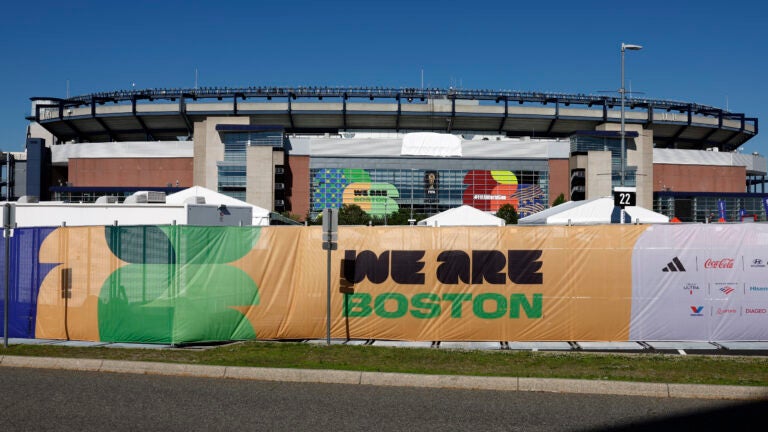
Boston-area officials are preparing to welcome thousands of international visitors for the 2026 FIFA World Cup. But for some fans, getting to Boston may be nearly impossible.
Travel bans affecting Haiti, visa backlogs, and heightened scrutiny for travelers from countries such as Iraq, Morocco, and Ghana have created uncertainty for supporters hoping to attend the tournament from abroad.
Advocates and fans say the barriers will leave some of the world’s most passionate soccer followers watching from home while their teams compete on one of the sport’s biggest stages.
“That’s not a fair game,” said Rachid Moukhabir, the founder of the Moroccan American Connections in Revere. “It’s either we play without supporters, or if we are allowing supporters in those stadiums, we need to let everybody bring their supporters.”
Geopolitical impacts locally
Gillette Stadium, which is being rebranded as Boston Stadium, has five scheduled games, with two more during the playoffs. Teams scheduled to play in Foxborough include England, France, Ghana, Haiti, Iraq, Morocco, Norway, and Scotland.
Haiti is subject to the U.S. Travel Ban; travelers arriving to the U.S. from Iraq, Morocco, and Ghana face months-long wait times and delays in obtaining travel visas. Immigrant visa applications for all four countries are paused.
The reason, according to the Trump administration, is to ensure that immigrants can be “self-sufficient and not be a financial burden to Americans.”
At Boston Stadium, the contrast could be especially visible during Haiti’s June 13 match against Scotland. Haitian supporters attending the game will largely need to be already living in the United States. Scottish fans, meanwhile, can more easily travel to the U.S. for 90 days or less through the Visa Waiver Program.
“It is a little bit appalling. It is inhumane. I will say it is discriminatory, and even say that it is racist that they have that type of travel ban on Haiti,” said Lionel Lucien, a member of the Toussaint Louverture Cultural Center of Massachusetts.
There is already a large population of Haitians and Haitian-Americans living on the East Coast of the U.S., and Lucien believes there will be enough support at the games regardless of the travel ban.
“I think the Haitians are going to be showing up in force,” he said. “We’re definitely looking to shock the world.”
A similar match-up will happen at the Scotland vs. Morocco game on June 19 and the England vs. Ghana game on June 23.
Even so, many Moroccan nationals already live in the U.S. and will be able to fill the stands, Moukhabir said.
“We will see a lot of red in the stadium, I’m sure about that,” he said.
Moukhabir is opting to put on a watch party in Revere instead of going to the games. He said he knows of only a few people from Morocco making the trek to the games. Most are unwilling to pay thousands of dollars for a ticket, flights, and hotels, only to be turned away at airport security.
“It’s very hard to put $5,000 on a gamble,” he said. “This doesn’t happen, even in the Mega Millions.”
Although Norway is not on the visa-waiver list, wait times at the consulate for a travel visa are less than 15 days — unlike in Iraq, where wait times are months long. The countries will play each other at Boston Stadium on June 16.
Ayham Saeed, a leader in the Iraqi community in Massachusetts, said he doesn’t know anybody willing to come to the games from overseas, saying the visa requirements and costs are too prohibitive.
But, there are a lot of Iraqi nationals living in the U.S. who will be traveling to the games from places like Maine, Michigan, and California, he said.
For a country hooked on football, he wishes that not only could people travel to the games but also could afford to go.
“There are a lot of people who want to attend these games, but with the cost of tickets, it’s hard. It’s really hard to get,” Saeed said. “There are barriers.”
Change in travel restrictions:
Obtaining travel visas to the U.S. hasn’t always been this difficult.
According to Matthew Maiona, an attorney at Maiona Ward Immigration Law in Boston, obtaining a U.S. tourist visa has become more difficult as the Trump administration moves to limit legal immigration for travel, work, and residency.
Even for countries not on the travel ban list, Maiona said, wait times at U.S. Consulates are long and vetting delays after the visa-stamping interview are considerable.
Since the current administration has taken over, Maiona said there have also been extensive layoffs and buyouts, further delaying visa reviews and issuance.
Add to that the requirement that fans have an official FIFA World Cup ticket to be part of the FIFA Pass, a priority appointment scheduling system, and it might be nearly impossible for someone to come.
The U.S. Department of State deployed more than 600 additional consular staff to support the FIFA Pass program, making millions of new visa appointments available for FIFA World Cup spectators, according to a department spokesperson. Since then, tens of thousands of World Cup ticket holders have utilized the new program.
The U.S. Department of State has had visa interview appointment wait times of less than 60 days in 80% of countries.
But Maiona said that, realistically, the only tourists making it to the World Cup from abroad are those using the Visa Waiver Program. Approximately 55 million foreigners hold a U.S. visitor visa, which they can use to travel to the games, according to a Department of State spokesperson.
“It’s excluding the rest of the world,” Maiona said. It’s also excluding the tourism dollars from people who don’t have tickets and want to come to take in the atmosphere or watch the parties.
“It is a point that it’s become detrimental to the economy and to the U.S. not to have visitors,” Maiona said. “But there’s not much you can do about that.”
As Brian T. O’Neil, a Boston-based immigration attorney, said, “When you put bans on 75 countries, 19 on immigrants and non-immigrant visas — the chilling effect is well known.”
Even for those living in the country, tickets can cost thousands of dollars, making a match unattainable for many.
“I mean, sports shouldn’t be this way,” Moukhabir said. “Everyone in the world has the right to support their team, and it shouldn’t be tied to their economic status. Sports are not made just for rich people.”
Related: The Haven, a taste of Scotland in Boston
Beth Treffeisen is a general assignment reporter for Boston.com, focusing on local news, crime, and business in the New England region.
⚽ Get the latest World Cup news
Receive updates on the 2026 FIFA World Cup
To comment, please create a screen name in your profile
To comment, please verify your email address
Source: Boston.com