
As the recent World Cup showed, the drama of a penalty shootout can at times be Shakespearean
Perhaps it was the stultifying heat wave that swept through the Mid-Atlantic in early July, making the couch in my air-conditioned living room seem especially inviting, or the depressing malaise of our national politics, or my despondence over tennis demigod Carlos Alcaraz’s absence from the French Open and Wimbledon because of a wrist injury, but the pleasures of this summer’s World Cup—which ended with Spain’s triumph over Argentina—proved more glorious than I anticipated. Part of the joy conjured up by the competition was in witnessing the nerviest of all ways to break a tie, unrivaled in almost any other major sport: the penalty shootout. Tennis has the tie break. Basketball and American football have the overtime period—a mini-game within the larger one. But penalties are an altogether different denouement, one that’s mesmerizing in its brutally administered finality. It may be the closest we come to seeing our sporting idols laid bare. Oxford professor Adam Smyth once compared the format to the epilogue of a Shakespeare play: “It continues the themes of the drama and gives meaning to what has gone before: but it also exists uniquely outside of it.”
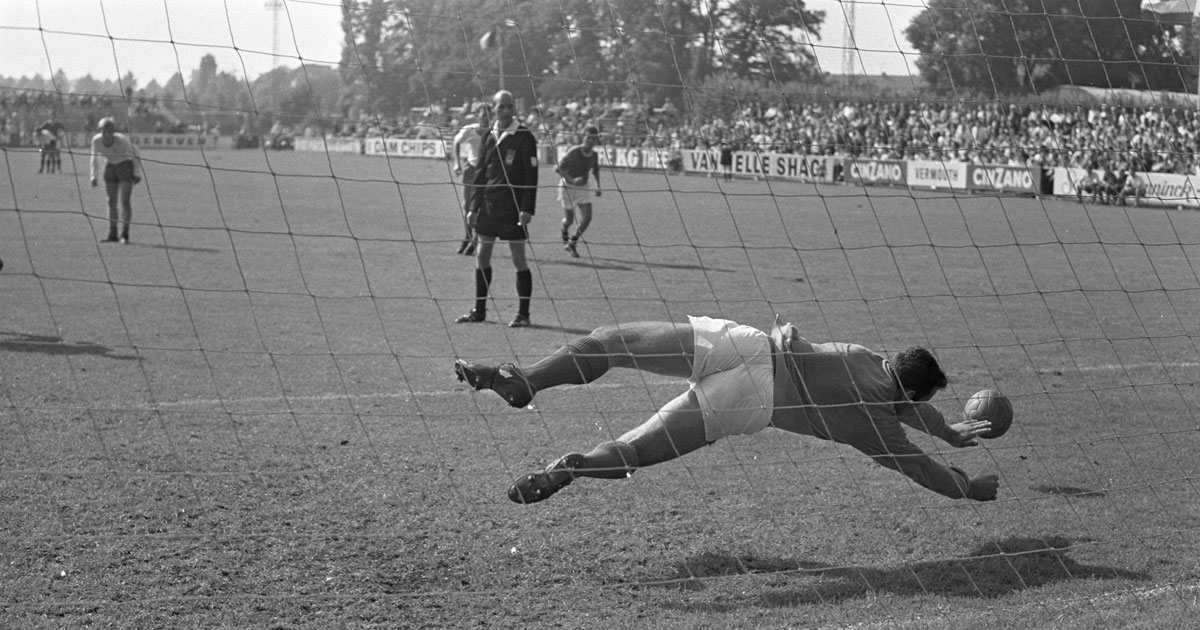
Consider the dramatic twist. For 120 minutes, two opposing sides circle the pitch, attempting to play the perfect through ball or cross in pursuit of that most difficult of breakthroughs—a decisive goal—only to have the final result come down to a series of one-on-one encounters: goalkeeper versus penalty taker, just 12 yards separating the two. That the advantage lies definitively with the penalty taker only adds to the already inconceivable pressure of the occasion, the fate of one’s nation riding on the outcome. The players spent, cramping, in the delirious haze of expended effort, now forced to march to the penalty spot and deliver the strike that will determine their fate: immortality or infamy.
It wasn’t always this way. Remarkably, among other tiebreaking mechanisms, soccer once relied on the drawing of lots, which is how Israel lost its quarterfinal match with Bulgaria in the 1968 Olympics, after the match ended 1-1 in regular time. That prompted Michael Almog, the future president of Israel’s soccer association, to write a letter to FIFA, in which he called the outcome “immoral” and “cruel.” Instead, he outlined a then little-used alternative as a more sporting way to resolve a draw: the taking of five penalties by each team. “I am not suggesting that this system is the best one,” Almog acknowledged—and many critics agree, viewing penalties as an ugly appendage to the beautiful game. “Rock, Paper, Scissors would arguably be a fairer way to choose a winner, or a breakdance battle at the very least,” writes Roger Bennett (of Men in Blazers podcast fame) in his new book, We are the World (Cup). But the shootout has endured, giving us a snapshot into something beyond just sports.
The Italian midfielder Andrea Pirlo, who took a penalty in the 2006 World Cup final, described the slow journey to the penalty spot as “an endless and terrible walk into one’s own fears.” But the experience awakened in him a profound sense of national pride. “Only in that moment I realized how great it was to be Italian,” he writes in his autobiography. “Looking back, I can say that tepid shiver I felt before scoring was by far the truest feeling I’ve ever felt in my life.”
When Pirlo and his teammates triumphed over a French side that had lost its talisman, Zinedine Zidane, after he headbutted Italian defender Marco Materazzi, they ended a streak of World Cup shootout misery. The Azzuri had lost in the quarterfinals to the French in 1998 on penalty kicks, in the semifinals to Argentina in 1990, and most infamously in the 1994 final to Brazil, when the sainted Roberto Baggio sailed his shot over the goal in Pasadena’s Rose Bowl. “The only players who miss penalties are those who don’t have the courage to take one. That time I missed,” Baggio writes in his autobiography. “I still dream about it.” After Baggio’s flub, an Italian band parodied it with a song, “La Cinica Lotteria Dei Rigori”—the cynical lottery of penalty shootouts. Indeed, anything can happen in penalties. Fast forward to the shootout on that same Pasadena pitch that decided the 1999 women’s World Cup final, when Brandi Chastain of the United States relied on some subtle subterfuge to bury China. Proficient with both feet, she surprised the Chinese goalkeeper by using her left foot for the first time from the penalty spot, her double-fisted celebration in a sports bra making the cover of Sports Illustrated and marking a breakthrough moment for the women’s game.
But in our age of big data, what was once considered a matter of fortune has become—to the extent that this is possible—one of preparation. Geir Jordet, a former player and now a professor at the Norwegian School of Sport Sciences, has pioneered the study of penalty kick psychology. Apart from everything his research has uncovered—turning your back to the goalkeeper after placing the ball on the spot makes you more likely to miss; so does rushing your take immediately after the referee’s whistle—he found evidence supporting the lingering effects of shootout-induced national trauma: Teams with a history of failure, even if the players responsible had long since retired, tended to fail at penalties time and time again. It’s as if the ignominy had somehow become embedded in the national psyche, the stigma of the past afflicting successive generations. An almost epigenetic sense of failure. Consider England, which, much like Italy, has suffered recurring shootout horrors in the World Cup. They were losers in the semifinals to Germany in 1990, in the round of 16 to Argentina in 1998, and in the quarterfinals to Portugal in 2006. Defender Gareth Southgate, whose missed penalty precipitated his country’s defeat against Germany in Euro 1996, reversed England’s fortunes when he became the national coach in 2016. England worked extensively on replicating the shootout format in training, and as he said, he would be the one to shoulder responsibility for the outcome. After all, he—and not the players themselves—would determine who would take the penalties and in what order; more than anything, his ambition was a psychological reset. His efforts were rewarded in the 2018 Cup, when England dispatched Columbia after penalties in the round of 16. The achievement, wrote Bennett in We are the World (Cup), “ranked up there with the Industrial Revolution, the works of Shakespeare, the development of the scientific method by Sir Isaac Newton, as great moments of English history.”
And yet the shootout resists too much study; it remains an enigma, an unpredictable and mystifying product of nerves, instinct, mental fortitude—and yes, luck. This year, in a shocking twist, Germany—winner of four previous World Cup shootouts—lost to Paraguay on penalties in the round of 32. Even more shocking was that the German side, this perceived paragon of reason and efficiency, had no predetermined schedule of shooters; instead, when a few key players demurred, defender Jonathan Tah volunteered, even though he had never before taken a penalty in a match. He missed, and gone was the illusion of German shootout invincibility.
In the same round, when Holland also crashed out in penalties, against Morocco, the failure highlighted the pressure-induced ineptitude the occasion can inspire. Four of the 10 strikes either hit the frame or missed the goal completely. (No one exhibited the stylish class of Zidane, who, before getting his red card for assaulting Materazzi in the 2006 Cup, had scored a panenka—a chipped penalty into the center of the goal that floated devilishly over the diving Italian goalkeeper. This cheeky bit of artistry was popularized in the 1970s by the Czechoslovakian midfielder Antonín Panenka.) But even so, the drama drew me in, like a scene from Scorcese. The Moroccan goalkeeper, Yassine Bounou, a penalty-defending wizard according to Jordet, put on a master class in psychological peacocking: double feints, hand jerks, bizarre motions—anything to get the taker to rethink his strategy when approaching the ball. His tactics especially frustrate penalty takers who deal in the art of the stutter step, halting their run up as they entice the keeper to dive one way before calmly delivering the ball into the opposite corner. For Holland’s final take, Bounou—or Bono, as he’s known—guessed right, making the save that dispatched the Dutch.
In the final this year, down a man entering extra time, Argentina’s hopes rested on making it to a shootout. But Spain managed to stave off the penalty lottery with an electric finish—and with it ended the Lionel Messi–mania that had animated the Cup with its near messianic zeal. Perhaps in four years, penalties will once again decide the final. These shootouts may have none of the physicality of an Erling Haaland headed goal, none of the pace of a Kylian Mbappé run into the box; none of the beauty of a confounding Messi finish. But they may reveal something far more intimate: the fortitude of a footballer having reached a sporting hinge point, with life forever divided into before and after. Cruel? Perhaps. But more dramatic than drawing lots.
Eric Wills has written about history, sports, and design for Smithsonian, The Washington Post, GQ, the Scholar, and other publications. He was formerly a senior editor at Architect magazine.
Source: Theamericanscholar.org