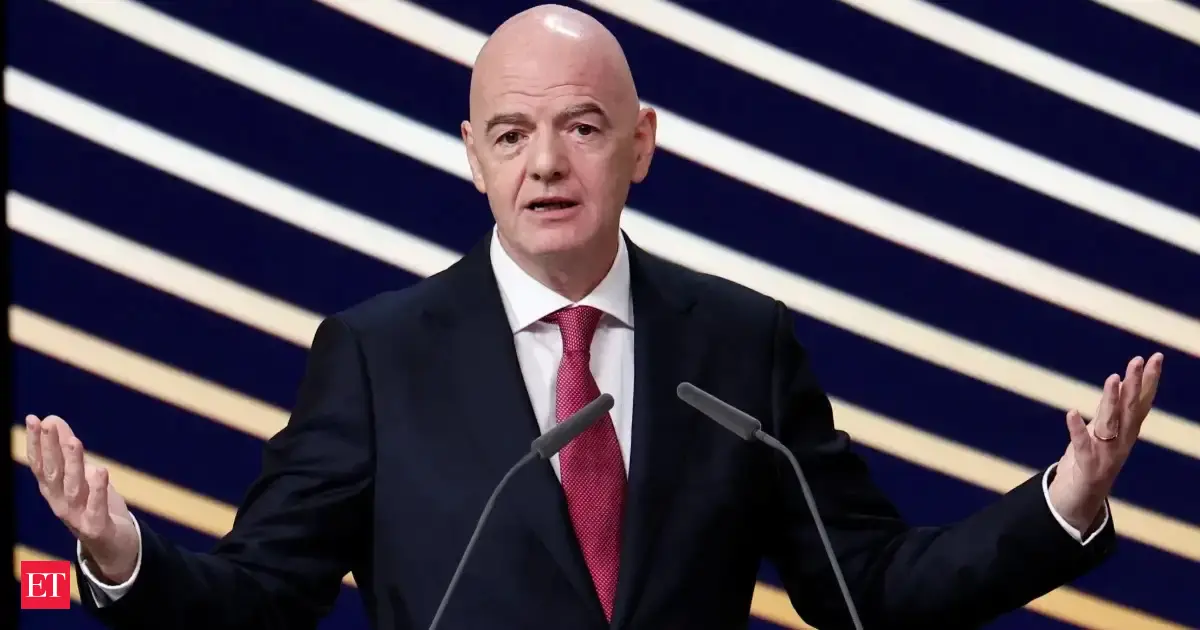

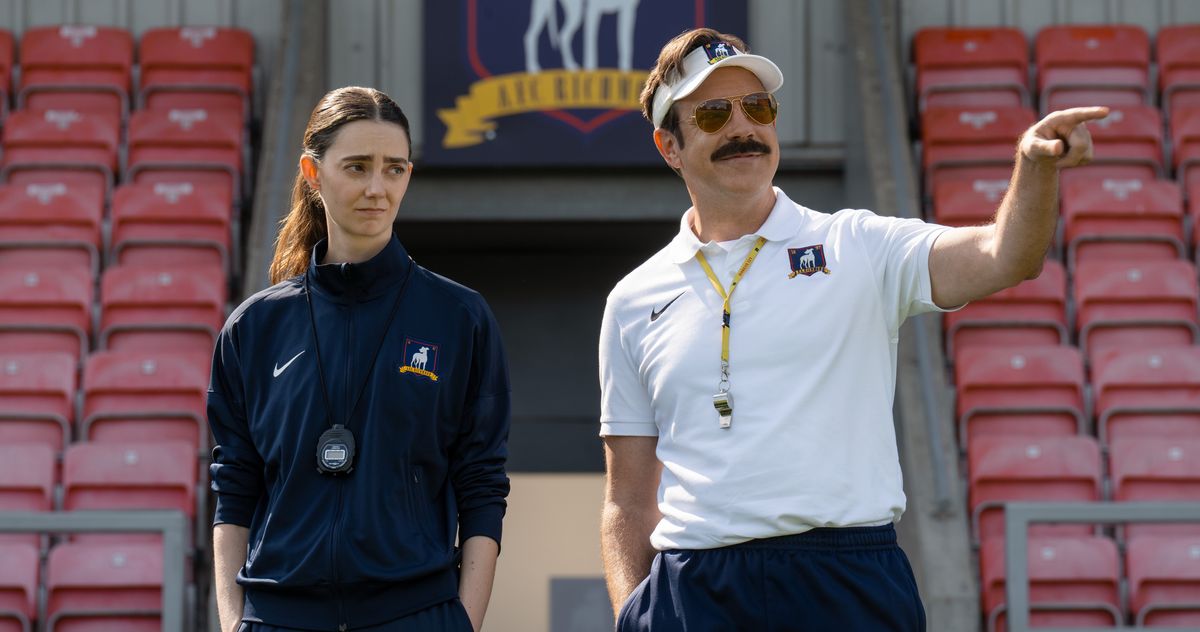
A cultural phenomenon that hasn’t yet been squeezed dry is too valuable to leave be. So it should come as little surprise that Apple TV and Jason Sudeikis have dragged the latter’s pathologically optimistic soccer coach out of the sunset he rode into at the end of Ted Lasso’s third season. After all, Ted Lasso, which Sudeikis created with co-star Brendan Hunt, Bill Lawrence, and Joe Kelly, remains one of television’s juiciest success stories: an NBC promotional sketch turned fish-out-of-water comedy that, for a time, became Apple TV’s defining original series as well as a beacon for men of a certain age trying to work through their issues. Its cultural footprint continues to loom large: Sudeikis and Hunt recently reprised their characters during the FIFA World Cup halftime show to introduce Justin Bieber, and it’s difficult to imagine the continued success of Welcome to Wrexham without Ted Lasso first breaking U.S. ground for feel-good soccer content. And with the World Cup’s rosy afterglow feeding the notion that the United States might have finally become a soccer nation, Apple would have been remiss not to ride that wave.
With Jack Burditt assuming showrunning duties (amid what appears to have been a messy production history), season four finds Ted back in Kansas City occupying the life that was supposed to represent his happy ending: becoming the present father he wanted to be. The series immediately undercuts that resolution, however, by placing him behind the checkout counter of a grocery store — a career choice that strains credulity for a coach who transformed a middling club into a Premier League contender — while he watches soccer from the sidelines and drifts through what’s clearly a quiet, unsatisfying existence. The inevitable disruption arrives when Rebecca (Hannah Waddingham), Keeley (Juno Temple), and Higgins (Jeremy Swift) drop by, supposedly to scout a Kansas City Current match as research for AFC Richmond’s new women’s team, the Lady Greyhounds. But like Apple TV itself, they can’t let Ted go, and the trip is really a recruitment effort to bring him back to England to head up the new operation. Ted dutifully agonizes over abandoning the life he spent the original run working toward, but the outcome is never in doubt. We wouldn’t be watching this show if the season premiere wasn’t going to bend the universe just enough to send Ted back across the Atlantic. Conveniently, both his ex-wife and son are now entirely comfortable with the move.
Dragging a character out of retirement is one thing; making sense of that return is another. Ted Lasso hasn’t been gone long, and based on the five of this season’s ten episodes made available to critics, that might be why its resetting of the board feels so conspicuously forced. The season opens with Ted no longer coaching his son, with the explanation reduced to a passing comment about how “father” and “coach” may be an unhealthy combination of roles. (Tell that to Jalen Brunson.) Beard and Jane (Phoebe Walsh) are no longer together, while Roy (Brett Goldstein) and Keeley are also on pause. More jarring is the dreamlike way Ted slides back into England. Everyone receives him with such warmth that it feels like a purgatory, where Ted has died and arrived in a place populated entirely by people who love and need him; Rebecca, who originally hired the soccer neophyte to sabotage the club, now regards him with near-religious adoration. The most contrived shift, however, is this season’s sudden distance from the men’s team. Aside from Roy, now head coach, the familiar players have disappeared: Jamie Tartt has apparently been shipped off, while Sam, Dani, and the rest of the squad are nowhere to be seen, at least for now, despite Ted being in literal close proximity to the locker room.
But who cares about the men anyway? The show now revolves around AFC Richmond’s women’s team. The premise theoretically provides a noble reason for the revival to exist beyond commercial interest, and it injects a fresh roster of players filled out by, among others, Faye Marsay, Abbie Hern, and Jude Mack. In broad outline, this is a new fish-out-of-water scenario that preserves the show’s original engine: Ted enters a world where he is an outsider (for he is a man) and must win over skeptics. This time, that main doubter is Alice Chilton (Tanya Reynolds), the Lady Greyhounds’ first assistant coach, who begins the season dubious of everything going on around her before predictably being won over by Ted.
The opening volley of this season exhibits the very same problem that plagued the bloated back half of Ted Lasso’s original run: Its unwavering commitment to a morally uncomplicated worldview leaves little room for texture, ambiguity, or any semblance of actual conflict. Rather than truly exploring its characters or any of the ideas it routinely gestures toward, the show routinely loops back into a smooth fantasy where everyone is fundamentally decent and reconciliation is the default destination. That flattening impulse is most apparent in the season’s handling of women’s sports, ostensibly its central concern. Early in the premiere, Higgins wanders into the Negro Leagues Baseball Museum, where an employee named Charles recounts the struggle Black players endured integrating professional baseball. “They didn’t do it for fame or fortune,” he says. “They did it because to not play would have been unacceptable.” When Higgins responds that the story reminds him of the decades women in England were barred from playing football, Charles immediately pushes back. “Not similar, sorry,” Higgins concedes. “What happened here — much worse, much, much worse.” It’s quintessential Ted Lasso. The show acknowledges the two histories aren’t equivalent yet invokes the comparison anyway, congratulating itself for recognizing the distinction while still harvesting the emotional weight of the analogy. Rather than examining the cross-comparative history with any depth, it settles for the reassuring glow of its own awareness, a form of smug liberalism that mistakes sensitivity for insight.
That tendency was easier to forgive in the first season because the series had a sturdy dramatic premise. Ted was genuinely out of his depth, the conflicts felt earned, and the show still had to persuade audiences that its relentless optimism wasn’t naïve. It also benefited from arriving during the pandemic, when a fantasy of uncomplicated decency felt genuinely restorative. Ambition didn’t suit Ted Lasso as it grew in appetite and latitude. By the end of season three, as Nate Shelley turned heel, Jamie Tartt worked through daddy issues, and Coach Beard went off on his own After Hours–esque adventure, the show came to feel increasingly self-indulgent and lazy in its reluctance to actually wrestle with whatever conflict it threw up on the board. Nothing about that approach has changed in this soft reboot. Its treatment of women’s sports is broad where it could be specific and simplistic where it should be curious. The obstacles are familiar: institutional sexism, underfunded women’s clubs, dismissive male audiences. The Lady Greyhounds begin with inadequate facilities, including a cramped locker room with barely functioning showers (a problem Ted inevitably solves through a burst of obvious ingenuity). Elsewhere, misogyny is reduced to cartoonish shareholders who lose interest the moment the women’s team enters the conversation.
These problems are real, but the show’s depiction of them cries out for more nuance and complexity. Professional sports involve hard questions about investment, infrastructure, and sustainability. The series briefly acknowledges as much when Rebecca and Higgins commission a study concluding that the women’s team is financially risky, only to brush it aside because it’s the right thing to do and they believe themselves special. The tension between principle and practicality — the very thing that could make this story interesting — gets mostly waved off, sublimated instead into interpersonal hang-ups. Rebecca feels a pang of discomfort after Chilton points out that she sought out Ted rather than seriously considering qualified women for the head coaching job. Later, she concedes, apologizes, and emphasizes that maybe there should be more understanding for what women of her generation went through. Another lesson in personal growth is all we get.
That’s ultimately why Ted Lasso feels so ill-suited to this subject. Women’s sports are no longer an underdog story waiting for easy applause but one of the most dynamic areas of modern sport, full of difficult, fascinating questions. The Barclays Women’s Super League still produces a fraction of the revenue that the world-beating Premier League does, but it continues to grow commercially in the wake of England’s Euro 2022 triumph. In the States, the National Women’s Soccer League is a booming business, working through the delicate growing pains of figuring out how to bridge grassroots support with rapid expansion. Beyond soccer, the WNBA has never been more culturally significant, producing a deep roster of bona fide stars while becoming a recurring political flash point. As I write this, the league is still grappling with the fallout from Sophie Cunningham’s comments about trans athletes, exposing tensions over inclusion, ideology, and the political diversity of a league long understood as culturally progressive. Those are the kinds of messy, unresolved questions that make women’s sports so compelling right now, and there’s a great show to be made about this moment. Ted Lasso, forever more interested in preserving an atmosphere of sterile niceness than grappling with complex humanity, isn’t it.
More TV Reviews
Tags:
- vulture section lede
- vulture homepage lede
- ted lasso
- ted lasso season four
- tv
- apple tv
- tv review
- jason sudeikis
- More
Source: Vulture