

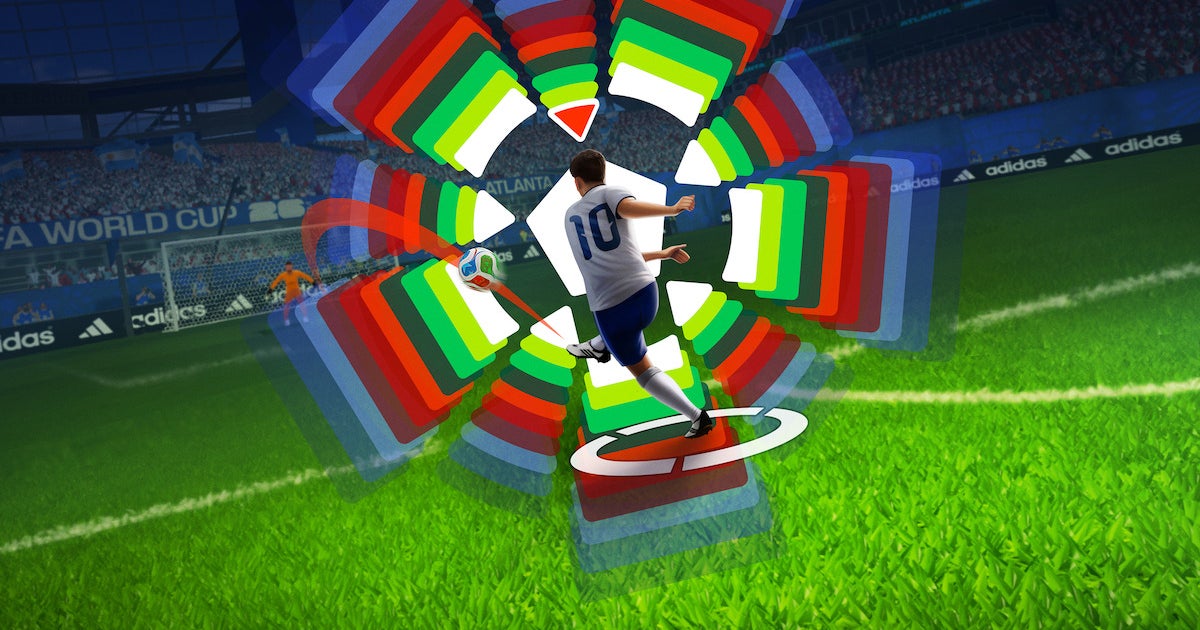
Since 2022, when FIFA and Electronic Arts ended their almost 30-year partnership, a wide range of new football video games have emerged, including the free-to-play title UFL and the Netflix exclusive FIFA World Cup: Launch Edition from Delphi Interactive.
"There is a trend toward offering more choice for fans. In other words, offering more games for more gamers," says Delphi founder and CEO Casper Daugaard.
"We’re also seeing games that are buoyed by trusted licenses continue to resonate well with players, and that games without licenses are struggling to get off the ground."
Eugene Nashilov, the CEO of UFL maker Strikerz, says that the sector is in its "most active phase in years".
"The market is becoming much more diverse," he says. "We now have a few full simulation games, arcade football, social football, mobile-first products, manager and fantasy games, and experimental platform-based experiences.
"At the same time, EA Sports FC and eFootball remain the leaders in audience, legacy, and commercial scale. UFL is one of the few projects directly challenging them in the full football simulation space. So I’d say the market is opening up, but it is still very difficult. Football is an attractive genre in gaming, but also one of the hardest to execute well."
From the perspective of eFootball maker Konami, the football market is in a "transition period", at least on the development side of things.
"Historically, the direction was shaped by annual premium releases, whereas it’s now evolving towards more diverse formats, such as free-to-play and live service models," explains eFootball general producer Junichi Taya.
"This has widened the target audience and made the space more dynamic, which has influenced how we build and deliver a football experience as we focus on continuous iteration. Simultaneously, player expectations have increased significantly as they expect authenticity in gameplay with consistent updates that keep the experience fresh. This shift has allowed us to reach and nurture growing markets through mobile and cross-platform accessibility, where new audiences are engaging with football games for the first time. Overall, it’s a healthy and growing market that constantly changes in how experiences are delivered and sustained."
But can EA's dominance be challenged?
Diversification
EA ruled the football roost for decades with its licensed FIFA games, while (despite its best efforts) Konami played second fiddle with the Pro Evolution Soccer franchise, now branded as eFootball. There were other popular experiences beyond those two, such as Sega and Sports Interactive's Football Manager franchise, but FIFA and PES were the main names.
FIFA and EA ended their partnership in 2022, reportedly over licensing costs, and EA rebranded its football series as EA Sports FC the following year. Not much has changed since then for the US publishing giant – despite the odd sales wobble, its football business appears to have held up. (the company did not answer questions from GamesIndustry.biz for this feature.)
FIFA, meanwhile, vowed to diversify its video game offerings, with president Gianni Infantino saying: "I can assure you that the only authentic, real game that has the FIFA name will be the best one available for gamers and football fans."
Earlier this year, the organisation announced its new Digital Football strategy, which sees multiple developers and publishers make games under its licence, including the already announced Netflix World Cup title from Delphi Interactive and Refactor Games.
On paper, FIFA's Digital Football strategy is a logical bet for the governing body. Rather than mostly going all-in with one partner, as it did with Electronic Arts, the organisation is spreading its bets across a variety of different studios and formats, ranging from Netflix to Roblox. The vision, according to those with knowledge of the strategy, is for a broad global reach with a particular eye on the youth market. That demands a robust presence in free-to-play and mobile, informing decisions like the rebrand of Gamefam's Roblox hit Super League Soccer to FIFA Super Soccer.
But the question is, can the market support this many experiences? Is the audience big enough to sustain this many different kinds of FIFA games?
"We believe that the market can support a range of experiences as they can offer varied gameplay interactions that deliver different value to players," Konami's Taya says. "As football invites a diverse global audience, we believe that there are multiple approaches to support them and provide meaningful moments across competitive, casual and social play. We believe it is important to continue providing game experiences tailored to the needs of different players, on the platforms that best suit those experiences. Increased competition offering different gameplay styles encourages innovation across the industry and pushes all of us to deliver meaningful experiences."
Strikerz's Nashilov agrees, saying that there is "room for variety" in the space.
"Football is huge and very diverse," he argues. "A 10-year-old playing on Roblox, a competitive PvP console player, a mobile-first player commuting home, a fantasy football fan, and someone who wants a quick social party experience are not necessarily looking for the same product.
"So the idea of tailor-made football experiences for different audiences makes sense."
He continues: "I also believe, however, that FIFA’s broader strategy will eventually need a truly top-tier FIFA-branded football game at the centre of the ecosystem. The FIFA brand is extremely powerful, but in gaming, brands need to be reinforced by great products to fall into the expectation basket of the community. The challenge there is execution. Football games are difficult to build and even more difficult to sustain. Retention, gameplay depth, community trust and long-term content quality are really hard to achieve."
"FIFA’s broader strategy will eventually need a truly top-tier FIFA-branded football game at the centre"
Delphi's Daugaard, who runs one of the companies involved in the Digital Football strategy, also believes that the initiative will please the widest variety of fans.
"There is a wide diversity of needs, both met and unmet, within the global football gaming community," he says. "A broader variety of football experiences has the opportunity to better serve existing players, while reaching the underserved football fans of the world."
This, Daugaard argues, is the big opportunity for football games at the moment – making the sport even more accessible to a large audience.
"There are hundreds of millions of gamers who love football that aren’t actively playing football games," he says.
"The next generation of football fans is evolving, and gaming is one of the key access points to connect with the beautiful game. Digital play is a key driver for why kids follow a sport.
"We’re also seeing some strong opportunities in emerging gaming markets, including MENA, Latin America, South East Asia and India, where growth in gaming mirrors the growth of football fandom. There is a ton of opportunity to bring more football game experiences to players in those parts of the world."
Cultural relevance
"Football is not just a sport. It is entertainment, competition, friendship, identity, influencers, clubs, leagues, players, fashion, memes, arguments, weekend rituals – ultimately, a lifestyle," says Nashilov.
"The opportunity is to build football games that understand and reflect the full cultural context, not only the 90 minutes on the pitch.
"We live in a hyperconnected world where football moments travel instantly through social media, creators and short-form content. A successful football game today needs strong gameplay, but it must also offer cultural relevance, live-ops energy and the ability to feel connected to what is happening in real football and the community."
Konami's Taya agrees that there is a "demand for flexibility and an approachable experience," but notes that one of the biggest challenges is "delivering a gameplay experience that feels authentic whilst still being accessible to a wide audience," since football fans are "very sensitive to realism."
"Alongside that, development costs and the demands of a live-service title of delivering constant updates and implementing improvements from community feedback continue to rise," he says. "These challenges, however, also create opportunities, as a live-service model allows for deeper, long-term engagement through cross-platform play and mobile accessibility. We focus on building closer relationships with players by responding to feedback and implementing improvements consistently to evolve the game over time."
Another challenge raised by Strikerz's Nashilov is the audience's desire for "something fresh".
"Major publishers are focused on CCG [collectible card game] progression systems built around powerful squad-building economies and live-ops content," he says. "Players engage with these systems heavily, but at the same time, there is also frustration. Many players feel that the genre has not changed enough in terms of gameplay, innovation or conceptually new experiences.
"Football may look simple from the outside, but making a great football game is extremely hard"
"Another challenge is execution. Football may look simple from the outside, but making a great football game is extremely hard. You need responsive gameplay, animation quality, AI, physics, matchmaking, licenses, content, economy, esports potential and constant live operations. Very few teams can sustain that at scale."
Daugaard agrees on the complexity point, noting some of the mazes that developers and publishers need to navigate to have a successful game.
"Rights to players, teams, and leagues can be complicated and expensive, and navigating that ecosystem is often required for long-term success at scale," he says.
"We also see a lot of barriers to play for new audiences – gaming hardware costs, premium pricing, and ongoing microtransactions can make the genre feel both expensive and intimidating for new audiences to find an on-ramp."
Evolution
While the rush of global interest in football generated by the 2026 World Cup is now winding down, the future appears bright for the football game market.
Nashilov believes that the genre will continue to "steadily" evolve; incumbent market leaders will build on the existing foundations, while new blood will try to enter the space with a variety of approaches.
"Some projects will find their audience. Some will not survive. That is normal," he says.
"The accessibility of game development is improving, so more football games will appear. But the top end of the genre still requires high-end technology, deep football understanding, production power and years of iteration.
"For me, the most exciting part is that football gaming is no longer standing still. The genre is becoming more competitive, more diverse and more culturally aware. That creates pressure, but it also creates opportunity – and I think players will benefit from that the most."
"The genre is becoming more competitive, more diverse and more culturally aware"
Konami's Taya adds: "We see a very positive future for the genre as football is truly universal due to its unparalleled global popularity and continuously evolves. We believe our strategy of consistently refining gameplay and building something that evolves alongside the sport itself resonates with players.
"A key part of that future is continuing to expand into and nurture growing markets, making football more accessible to new audiences while supporting existing players. For example, we will continue to make ongoing investments in game servers, which are essential for action football games, while working with global companies to provide a comfortable, competitive environment for our continuously growing users. With eFootball, our focus is on building an ecosystem that can grow over time and evolve alongside our global community."
This positive sentiment is carried over by Delphi's Daugaard, who says that a greater variety of experiences is only a good thing for the genre.
"We expect growth overall, just as both football fandom and gaming continue to grow globally," he says. "More diverse football gaming experiences can help make the genre more accessible, and ultimately democratise and globalise football gaming for more people."
Source: GamesIndustry.biz


