
Precarious contracts, international mobility, pressure for quick wins and an obsession with league tables. Sound familiar?
The Olympic sport that influences my lab leadership style
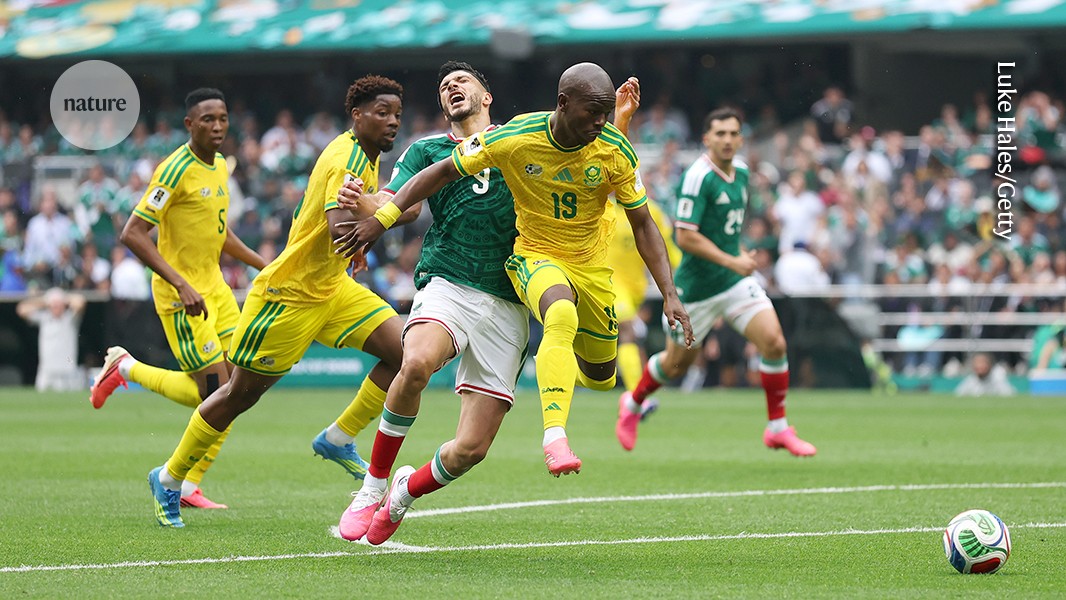
You’ll probably recognize these realities of academic life. But you might be surprised by how much you have in common with the professional footballers battling it out at the men’s FIFA World Cup 2026 and other high-level tournaments (perhaps not the salaries).
At the early-career stage, both professional footballers and academic researchers are driven by the kind of passion and talent that can demand sacrifices in home life, leisure and personal time. For players, this means long hours at the training ground dreaming of a winning goal in the national league or on the international stage. For researchers, it means hopes for a breakthrough discovery or highly cited paper.
But success in both soccer and science requires more than talent and dedication. It also demands resilience, adaptability and a willingness to remain constantly on the move.
For elite footballers, this is down to the transfer system, through which players get sold to clubs around the world. For working scientists, it means ‘academic mobility’ — moving between research groups near and far, depending on where your expertise is most valued.
Both moves can involve uprooting your life, adjusting to new colleagues and cultures, and occasionally learning a new language, before the cycle begins again a few years later. Short-term contracts make long-term planning difficult. In both research and football careers, you might always have an eye on your next contract. Yet insecurity does not necessarily disappear for those who secure a permanent academic position.
In football, there is always the prospect of landing a position as manager or head coach, allowing you to stay in the profession. In research, the equivalent is to become a group leader or professor. Ironically, both promotions bring a whole new set of skills and challenges: people and resource management, recruitment, mentoring, training, budgeting and pressure for your team to deliver results.
Papers published, goals scored
Whereas football managers are judged on league position, researchers are evaluated through publication metrics, grant income and international profile. These parameters influence promotion prospects, future funding opportunities and even an institution’s position in national and international league tables, similar to a football club. Furthermore, a talented researcher or group leader might be headhunted on the basis of their h-index, much as footballers and their managers are because of their goal-scoring record.
What elite sport prepared me for in the lab — and what it didn’t
For those who succeed in football, there are rich pickings — a place in the national team, a seven-figure salary, media and sponsorship opportunities galore. Successful researchers are very unlikely to enjoy Premier League wages or global fame. Their victories are more about impact: a treatment developed, a problem solved, knowledge advanced.
Enjoying our latest content?
Log in or create an account to continue
- Access the most recent journalism from Nature's award-winning team
- Explore the latest features & opinion covering groundbreaking research
doi: https://doi.org/10.1038/d41586-026-01794-0
This is an article from the Nature Careers Community, a place for Nature readers to share their professional experiences and advice. Guest posts are encouraged.
Competing Interests
The author declares no competing interests.
Related Articles
Subjects
- Careers
- Lab life
- Funding
Latest on:
- Careers
- Lab life
- Funding
- How should I respond to race-based exclusion in my lab? Career Feature 23 JUN 26
- My diverse academic background is affecting my PhD studies — what do I do? Career Feature 11 JUN 26
- Five winning images of scientists at work Career Feature 10 JUN 26
- My diverse academic background is affecting my PhD studies — what do I do? Career Feature 11 JUN 26
- Let’s talk about biomedical research kits Career Column 09 JUN 26
- My overseas job offer was rescinded. Here’s how I bounced back Career Column 09 JUN 26
- Inside the new political screening that’s stalling NIH grants News 26 JUN 26
- US funding uncertainties threaten to sink key global oceanography projects News 25 JUN 26
- ‘Us’ not ‘them’: scientists must use their skills to help stop polarization and division Editorial 24 JUN 26
Jobs
- Chief Magazine Editor The Chief Magazine Editor will be involved in shaping the strategic direction of Nature, including in digital media. London, New York or Washington DC - Hybrid working model Springer Nature Ltd
- Interim Associate or Senior Editor, Nature Energy Job Title: Interim Associate or Senior Editor, Nature Energy Fixed Term Contract, Full-Time Locations: London or Milan – Hybrid Work About Spri... London (Central), London (Greater) (GB) Springer Nature Ltd
- Faculty Positions in Westlake University Founded in 2018, Westlake University is a new type of non-profit research-oriented university in Hangzhou, China, supported by public a... Hangzhou, Zhejiang, China Westlake University
- University of Chinese Academy of Sciences (UCAS) Global Faculty Recruitment We are seeking distinguished scholars who will teach at UCAS while conducting research at CAS institute platforms—focusing first on over 20 key areas. Beijing (CN) University of Chinese Academy of Sciences (UCAS)
- 2027 Overseas Outstanding Young Scholars: NKU Invites Talents From Around the World Nankai University sincerely invite outstanding talents at home and abroad to apply for the 2027 Overseas Outstanding Young Scholars Fund. Tianjin, CN Nankai University
Source: Nature.com