

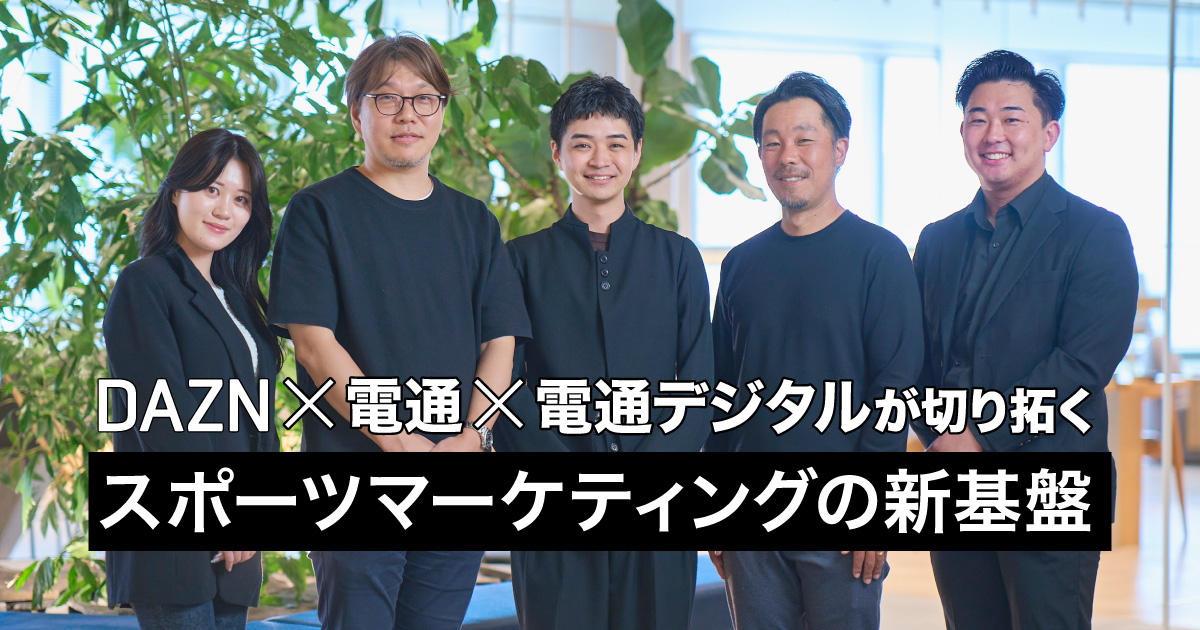
As sports viewing experiences become increasingly diverse, it is becoming more difficult to understand how fan behavior and enthusiasm translate into marketing results for clients. To address this challenge, DAZN, Dentsu Inc., and Dentsu Digital Inc. have developed the “DAZN Open Marketing Engine,” a marketing platform that visualizes sports fans’ behavior from a people-centric perspective. In this article, we spoke with them about the background, use cases, and future prospects of this initiative.
<Table of Contents>
▼Capturing Sports Fans’ Behavior from a People-Centric Perspective and Visualizing Advertising Effectiveness
▼Reaching Audiences Unreachable via TV and Contributing to Business Growth
▼Transforming Sports Enthusiasm into Marketing Power
Understanding Sports Fans’ Behavior from a People-Centric Perspective and Visualizing Advertising Effectiveness
―― Please tell us about the background behind the launch of the “DAZN Open Marketing Engine.”
Nose (DAZN): We felt there was a major challenge in that we were unable to fully visualize the marketing results associated with advertising on DAZN. How did exposure to DAZN ads lead to actions such as visits to websites or stores, or purchases, and how did that contribute to our clients’ marketing ROI (mROI)? Our starting point was to clarify this based on facts, with the support of Dentsu Inc. and Dentsu Digital Inc.
The Dentsu Group possesses and integrates a diverse range of data that helps unravel consumer behavior, including actual TV viewing data (STADIA360*), purchase data, and large-scale location data that enables the measurement of activities such as stadium attendance and store visits. Furthermore, they have extensive expertise and a proven track record in the development and operation of data clean rooms. Based on these factors, we chose to partner with them on this project.
*STADIA360: An integrated marketing platform that enables the delivery and effectiveness verification of digital ads based on viewing data sourced from TV manufacturers—obtained with user consent—across 15.6 million connected TVs (TV sets connected to the internet) in Japan.
Katsuzawa (Dentsu Inc.): DAZN is one of Japan’s leading sports-focused OTT* platforms. We believed that, from a marketing perspective, it holds significant value as a medium that captures the intense passion of sports fans, particularly through live viewing.
On the other hand, to demonstrate how the passion of these sports fans impacts our clients’ marketing results, we need to analyze viewing behavior and ad exposure on DAZN in conjunction with ad exposure across other media—including TV commercials—as well as user behavior before and after those interactions. Dentsu Inc. and Dentsu Digital Inc. also wanted to visualize the power of sports content in terms of advertising effectiveness and business contribution.
*OTT (Over-The-Top): A general term for services that deliver content such as video (movies and live sports broadcasts), music, and games via the Internet without using broadcast networks or dedicated lines.
――Please tell us about your unique strengths and features.
Hayashi (Dentsu Digital Inc.): “DAZN Open Marketing Engine” is a data clean room that, based on consumer consent and within a secure environment that safeguards privacy, combines diverse data sets to analyze sports fans’ behavior and the effectiveness of DAZN ads from a person-centric perspective.By integrating data held and shared by Dentsu Inc., DAZN’s viewing and ad exposure data, as well as data held by various sports stakeholders—including sports federations, leagues, and clubs—we can gain a more comprehensive understanding of fan behavior.
A particular strength of this solution lies in its ability to utilize not only DAZN’s ad exposure data but also viewing data for sports content, including live broadcasts. A key feature is the ability to analyze the relationship between ad exposure and subsequent behavior, taking into account which sports and content fans engage with and the level of their enthusiasm.
Kimura (DAZN): From DAZN’s perspective, we feel this represents a major shift—by combining our data with that held and integrated by Dentsu Inc., we can now capture sports fans’ behaviors that were previously difficult to discern through DAZN alone. Our analytical scope has expanded beyond viewing behavior and ad exposure on DAZN to include watching programs and broadcasts on terrestrial TV, attending stadium events, visiting websites and physical stores, and making purchases.
As a result, we can now demonstrate how sports fans’ enthusiasm translates into ad exposure and subsequent actions, allowing us to communicate the value of DAZN advertising to clients in a more concrete way.
Reaching Audiences Beyond Television and Driving Business Impact
――What kinds of analyses are possible by utilizing the “DAZN Open Marketing Engine”?
Harahara (Dentsu Inc.): In addition to reach analysis when combining TV commercials with DAZN ads, we’ve designed the system to cover a wide range of metrics, including verifying the contribution of ad exposure to subsequent website visits, store visits, and purchases.
For example, from a reach perspective, by comprehensively analyzing exposure to both TV commercials and DAZN ads, we can identify overlaps in the audience and measure the incremental reach newly acquired through DAZN ads. This allows us to demonstrate the extent to which DAZN ads are reaching audiences that are difficult to reach with TV commercials alone, enabling clients to gain a more multifaceted understanding of the effectiveness of their media investments.
Furthermore, in terms of post-exposure behavioral analysis, we can compare the differences in website visit rates, store visit rates, and purchase rates between those exposed to DAZN ads and those who were not. By combining this with analyses of ad effectiveness by day of the week and time of day, trends based on the number of ad exposures, and demographic analysis of the target audience, we can go beyond mere effectiveness verification to improve the accuracy of future ad placement plans and communication strategies.
――Please tell us about some actual use cases.
Haribara (Dentsu Inc.): In a project with a client in the financial industry, we measured the overlap and incremental reach between TV commercials and DAZN ads, and also verified their contribution to website visits. The results confirmed a relatively high level of incremental reach acquired through DAZN ads, demonstrating that we were efficiently reaching audiences that are difficult to reach through TV alone. Furthermore, we confirmed that ad exposure led to subsequent website visits.
Furthermore, in a case study involving an automotive dealer client, a notable finding was the significant lift in store visit rates among those exposed to DAZN ads compared to those who were not exposed to any ads. Moreover, an analysis of visitor demographics revealed that the ads reached not only those with a high interest in cars but also segments whose family structure and life stage suggested a natural affinity for automobiles.It is possible that the combination of heightened enthusiasm generated by watching sports content and consumers’ pre-existing interests and needs led to in-store visits.
――How do you interpret these analysis results?
Nose (DAZN): It was very encouraging to see that the incremental reach exceeded our expectations. At DAZN, we believe it is important not only to demonstrate the value of advertising but also to visualize how we are contributing to our clients’ businesses.
It’s not just about serving ads and calling it a day; we apply the analysis results to our next initiatives. I believe the value of this solution lies in our ability to keep that cycle going.
Kimura (DAZN): Being able to provide more fact-based reporting on ad effectiveness—something we hadn’t been able to do sufficiently in the past—is a major step forward in explaining the value of DAZN ads to our clients.
We can now concretely show clients what kind of new reach DAZN ad exposure generates and how it leads to actions such as store visits. By continuing these analyses, we believe we can accumulate insights into the conditions under which ads are most effective, as well as which types of sports content and ad designs are most likely to drive results.
Turning the Passion for Sports into Marketing Power
――How do you plan to evolve this initiative going forward?
Kimura (DAZN): Currently, we’re primarily utilizing online viewing data from DAZN, but going forward, we plan to link this with real-world behavioral data, including stadium attendance. Many DAZN users have made live viewing a habit, and the completion rate for live content is very high, at around 95%.
By linking online viewing behavior with real-world behavior, we believe it will become easier to leverage the live nature of sports content and the passion of fans for marketing purposes.
2026 is also a year filled with major sporting events. Even for the FIFA World Cup currently underway, we are utilizing the “DAZN Open Marketing Engine” to develop analytical tools that capture viewing behavior during the tournament as well as behavior before and after it.
Nose (DAZN): We believe it’s important not only to visualize advertising effectiveness but also to apply the insights gained from that data to ad delivery and campaign design. For example, by examining the behavior of people watching games at the stadium, we may be able to identify various journeys, such as travel and purchases before and after the game.
If we can identify such trends, we should be able to design our clients’ marketing activities more effectively, timed to coincide with moments when sports fans’ enthusiasm peaks. We hope to further demonstrate, through future case studies, how the passion inherent in sports can contribute to our clients’ marketing and business results.
Haribara (Dentsu Inc.): Moving forward, the three companies plan to continue collaborating to develop this solution into a platform that can be tailored to address our clients’ specific marketing challenges. The name “DAZN Open Marketing Engine” embodies our desire to expand the possibilities of marketing not just within the three companies—DAZN, Dentsu Inc., and Dentsu Digital Inc.—but through collaboration with clients, data partners, and various other stakeholders in the sports world, including sports governing bodies.
Through such collaboration, we aim to capture previously unseen behaviors and insights among sports fans, which will help clients develop more effective strategies and advance sports marketing.
Hayashi (Dentsu Digital Inc.): I feel there is still significant room for this solution to evolve. By incorporating various data sources and analytical methods in the future, we may uncover sports fan behaviors and insights that even we ourselves did not anticipate.
We will not limit the insights gained from this initiative to effectiveness verification alone; we will also apply them to future ad placement plans, communication design, and the advancement of ad delivery. We want to develop the “DAZN Open Marketing Engine” into a solution that generates insights leading to tangible marketing results for our clients.
Source: Dentsu-ho.com

