

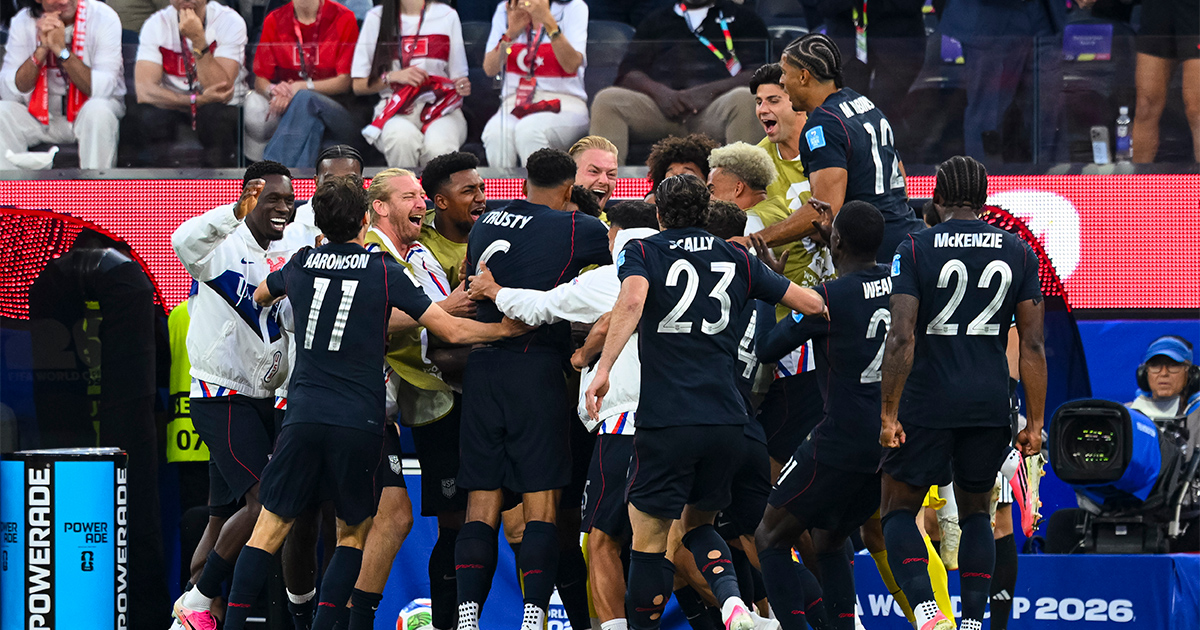
With the country’s golden generation of players coming into their prime — and with an infusion of Philly-area talent — the U.S. men’s national team stands on the precipice of a historic World Cup run.
The U.S. Men’s Soccer team celebrate their goal during the FIFA World Cup 2026 Group D match on June 25, 2026. / Photograph by Julian Medina/Eurasia Sport Images/Getty Images
Listen to the interview edition here:
If you’re anything like me, you’ve spent the past three weeks glued to your TV or phone watching the men’s World Cup. And if you’re also anything like me, you’ve spent much of that time dumbfounded by the quality of play from the U.S. men’s national team, a team that I’ve rooted for my entire life despite being perpetually let down by their performances. (As Philadelphians, we’re familiar with this feeling.)
To make sense of my conflicting emotions, I spoke with author and journalist Leander Schaerlaeckens, whose new book The Long Game: U.S. Men’s Soccer and Its Savage, Four-Decade Journey to the Top, or Thereabouts, came out May 12th. Our conversation, which was recorded before the July 1st U.S.-Bosnia and Herzegovina match, has been edited and condensed (but not much because we both had a lot of thoughts).
Philly is hosting six matches, and I know that you were at Curaçao-Ivory Coast in Philly the other day. So, what was your impression of Philly?
This is going to sound like I’m pandering terribly to you and your audience, but I submit that, to my sort of sensibilities, Philadelphia is the perfect American city in that it’s walkable, it’s interesting, and it’s affordable. It’s got a good climate. Aside from an NWSL team, you’ve got just about every sports team or a team in every league that you would like. Maybe they aren’t run the way you would like, but you have one of all of them, since you’re about to get a WNBA team. The climate is solid. I like Philadelphia a great deal.
Well, I think you’re off to a great start here from an audience perspective.
That work for you?
We’ll send it to the tourism bureau.
Please do.
I played soccer through high school, and I’ve watched probably every U.S. men’s national team match that has mattered for at least the last 20 years. And when I was watching the U.S.-Paraguay game, I had to watch it again the next morning because to me it was the most creative, best game I’ve ever seen the U.S. play. You just wrote a whole book about the history of the U.S. men’s national team, so: Did you have a similar experience, or was I just way over-speculating?
No, I think that’s exactly right. Writing this book, I went back and watched every World Cup game the U.S. has played, going back to 1990 because that’s as far as we have footage. There’s no footage of 1950 and they have never looked as good as they looked in those first two games at the World Cup, particularly the first one against Paraguay.
Things were a little cagier in their second win over Australia, because it was a very, very physical game, and then in the third one they played their scrubs against Turkey and didn’t lose until deep, deep, deep in injury time, but they were okay then.
What they’ve managed to do is cobble together the sort of traits that historically allowed a U.S. team that didn’t have as much talent as its opponents to compete: run hard and run a lot and be really organized and be really sort of feisty. We kind of lost some of those qualities for a little while, and [U.S. coach] Mauricio Pochettino has not only brought them back, but has managed to kind of layer on top of that a tactical acumen and a technical ability that we always knew was present in this generation of players.
The term “golden generation” gets thrown around in soccer, which tends to refer to a team that’s just exceptionally talented, because in international soccer you’re really beholden to the whims of whatever talent comes through, right? It’s not like club soccer, where if you need a left back, you just go and buy a left back, or you need a right winger, you just go and get one. In international soccer, you can only field the players who have the passport of your country, right? So, if you have this really great generation of attackers coming through, but no defenders, well, trouble, right? It’s not going to work out.
So one of the things that was exciting about this team is that it’s, a.) really complete, and b.) we’re finally developing the technical players that the U.S. had always kind of aspired to developing. Part of that was a little bit of luck, part of that was the legacy of birthright citizenship. Striker Flo Balogun happened to be born here quite by accident, because his mom wasn’t allowed to fly back to England because she was too pregnant, and she was basically told by the airline, “No, you have to stay in New York and have this baby, and then you can fly back to England.”
So there are a few strokes of luck. Malik Tillman, one of the most technically astute players, and Sergiño Dest, they were born in Germany and the Netherlands, respectively, to American servicemen fathers. So, there’s a bit of luck involved there as well. But what you’re now seeing is what’s possible when those two things come together, when you get that mindset that the U.S. team has always sort of harnessed, and you get the actual soccer ability on top of that. Good things are suddenly happening.
There were these really brief moments where I just remember seeing a player do a move or take on a defender in a way that was just … like when Christian Pulisic split those two defenders, or Alex Freeman did that flick in the box, just a back heel that didn’t even go anywhere, but I was just thinking watching that this is just a totally different way of playing soccer for an American team.
What’s fun about them too is there’s a looseness about them. There are teams that — and you saw this in Brazil in 2014 — that are just completely crushed by the expectation of doing well on home soil. And they’re just stiff with tension. This U.S. team is so far — we’ll see what it looks like against Bosnia in the next round — just kind of having fun, and is just still possessed of that same, you know, sauce, as they say in the game, and they’re doing their little tricks and their little flicks at the appropriate moments. They’re just really having a good time, and that kind of radiates off of them, and that makes them fun to watch.
You said something in the acknowledgments at your end of your book that I thought was really interesting. You said, “I spent the next three years seeking to answer the question, ‘Why does the U.S. feel like it needs to win the World Cup?’ and by retracing that road from the dark ages of American men’s soccer to a present that is hardly without issues, but is by comparison positively luminous. The men’s national team is not there yet, but when you take a step back and take the macro view, the amount of progress made in a few generations is fairly miraculous.”
This is a team that didn’t even make the World Cup two World Cups ago, and now people are like “Wow, this is a team that could actually beat some bigger, more traditionally powerful teams in the world.”
Missing that 2018 World Cup is the great trauma of modern American men’s soccer, but it also, in a lot of ways, cleared the decks for this team.
We all knew that there was a really, really promising generation coming up that wasn’t quite here yet. There was a series of weird things that happened that caused the U.S. to miss that World Cup, but aside from Christian Pulisic, that team was laden with veterans who were clearly over the hill and who were coreless and who were not going to do a whole lot at that World Cup.
So, what missing that World Cup meant is that that team was cycled out probably a year earlier than it otherwise would have been. Tyler Adams and Weston McKennie made their debuts [that next year]; I think they were 17 and 18, respectively, or something like that. And that wouldn’t have happened for probably another year, and nobody was paying attention. Nobody was watching, and it allowed the interim head coach, Dave Sarachan, to basically start over and to just field all of these kids who were probably not ready for that level. But there was nothing to lose at that point because they weren’t going to the World Cup, and so it accelerated the development of this team significantly.
They just started over, so that by the time they got to Qatar in 2022 they were the second-youngest team at the World Cup. So those guys were ready to go by Qatar, and that was kind of their rehearsal for this World Cup. So, in some ways a lot of good came out of missing the World Cup in 2018.
Going into this World Cup, I really didn’t know where to set my expectations. You had Adams and Pulisic injuries, you had sort of injuries all over the place really, and very quickly into the Paraguay match I’d forgotten that I was being dismissive of the team. Do you think that fan expectations were accurate before the World Cup started, or, perhaps, do you think they’re too overblown now?
This team has been all over the map for the last year. In the fall, they had this run of five games that they played against teams that also qualified for the World Cup. They won four of them, they tied another, they were flying. They battered two-time world champions, Uruguay, who are in a mess right now, but nevertheless they beat them 5-1.
Then, in the spring, they played Portugal and Belgium, and they looked terrible, right? So, we were all like, “What do we do?” Because, as you mentioned, Christian Pulisic has not been entirely healthy, and actually went six months without scoring a goal with his club team, AC Milan. All these different players were not coming into this World Cup on the kind of runs that you would have hoped for, and then you kind of set that in parallel to the fact that when mainstream America catches on every four years, this kind of sporting exceptionalism kicks in, right, this idea that any sport that the U.S. takes seriously, we should be a global power in.
That’s what animates a lot of the anxiety around the men’s national team, and that’s just not been true with soccer, because there’s 210 other countries that take soccer very seriously as well, so it’s … you’re always kind of massaging the expectations of some news anchor who said, “Are we going to win the World Cup?” No, because only eight countries have ever won the World Cup; Belgium has never won one and Portugal has never won one and the English last won one in 1966. So you’re always kind of modulating between those two extremes. I think maybe expectations from the people that actually watched this team were possibly a little lower than where they should reasonably have been, and people who don’t watch this team, they were probably too high. So, maybe if you take the aggregate we were just about in the right spot.
I’ll take that. Alright, if there’s one thing that Philly loves more than its sports teams, it is it’s sports teams that also have an athlete from the Philadelphia area, and there are three on the men’s national team right now: Auston Trusty, Matt Freese, and Brendan Aaronson. They’ve all played a little bit different roles on the team so far this year. Let’s talk through a little bit about each of them, and what they mean for this team, and whether that has changed. I think Trusty, especially, has changed a little bit since before the Cup started.
Trusty was not considered a leading player. He’s a central defender; he wasn’t going to be a starter. He still hasn’t been a starter, because he plays in the same position, more or less, as Tim Ream, who’s the 38-year-old captain, who can’t run at all anymore, but is so good on the ball and so experienced that they keep him in the team, and with reason. Trusty is much younger, and he played against Türkiye in the third group-stage game. Trusty was really great; he scored a goal, which you wouldn’t expect for his position. That isn’t necessarily a mark of having a good game, especially as a defender, but he looked super, super strong. So, I wouldn’t be surprised to see more of him in the tournament. Then again, is he a first-rate starter? I’m not sure.
Matt Freese is fascinating. His family moved around a bit, but he spent most of his childhood in the Philadelphia area, and then he came up with the Philadelphia Union (as Auston Trusty did,) and he is the son of a world-famous, now deceased neurosurgeon who pioneered gene therapy. I wrote a profile of Freese that ran on ESPN.com; everybody in his family is from this long line of scientists — his grandparents were immigrants who worked as scientists for NIH, his aunt is an astrophysicist at the University of Texas, there are all these PhDs in the family. And his siblings … his sister is a professor, and the others work in tech and in finance, because, you know, that’s where America funnels smart people.
They don’t typically funnel them to goal.
Exactly. What’s interesting about Matt is that even though he’s a Harvard graduate — he could have gone pro right out of high school, but as a kind of compromise with his dad he went to Harvard, which is where all the siblings went except for his sister, who slummed it at Georgetown — he’s only spent three semesters on campus. He finished his Harvard degree by either taking classes online or commuting from Philadelphia to Cambridge to sit for tests and stuff like that, which is really impressive to have done at the same time as being a professional goalkeeper. Nevertheless there’s kind of like this weird sense, and he sees himself this way, that he’s the underachiever in the family because just hanging out in professional sports. So he’s very interesting.
Brenden Aaronson came through the Union academy as well, plays in England now, for Leeds in the Premier League, has always been kind of that prototypical sort of 1.0 American player: he’s not the most technical guy in the world, but he’s just really, really feisty.
I always think of him as pesky.
He’s a pest on opposing teams. He just does not stop running, he does not stop badgering them. He’s the kind of guy when you play pickup soccer that you really don’t want to play against because it’s just annoying, because you know you’re gonna have to work that much harder to keep the ball. And it’s like, why are we doing this? Come on we’re just trying to have fun here. Brenden Aaronson does not seem like he’s having fun, he’s just trying to do everything he can, both legal and illegal.
So I won’t put you on the spot too much, but we’re recording this before the Bosnia game and, not to look too far ahead, but I have nightmares about Belgium because of the 2014 World Cup. Our Round of 16 game would be either Belgium or Senegal. So, what are your thoughts on the road forward for the U.S. team right now?
I have mixed feelings here, because I grew up in Belgium. So, Bosnia should be winnable, but these are knockout stages, weird things happen in soccer. One team can dominate the other, and then a ball goes in off someone’s backside and something entirely different turns out to be the result. So definitely don’t look past Bosnia. But it will more likely than not be Belgium, although Senegal is really good, they’re the African champions with an asterisk because of all kinds of stupid legal wrangling.
Listeners can look that up, we don’t have an hour to walk through all that.
That’s an hour-plus conversation. [Editor’s note: If you’re interested, read this.]
So, the U.S. lost 5-2 to Belgium in March. Belgium eliminated the U.S. at the 2014 World Cup. I was at that game. What’s funny is that the core of this Belgian team now in 2026 is not that different from the Belgium team in 2014. That was a golden generation, and this team still has a lot of the guys from back then: Kevin de Bruyne, Romelo Lukaku, Thibaut Courtois in goal.
De Bruyne, one of the all-time great midfielders, gave this interview where he was asked, “Can you win the World Cup?” He has a bit of a filter issue, and he said, “No chance, we’re too old.” He actually said that ahead of the 2022 World Cup. And this team is more or less the same, so they’re old, they’re sort of this collective of aging superstars who hopefully the U.S. can finally figure out a way to beat.
That would get them into the quarterfinals, which would match the modern high watermark from 2002. Will the U.S. ever match their result from the 1930 World Cup, the first World Cup ever, where they came third? I’m not so sure. That’s a big ask. They kind of set the bar too high for themselves right at the outset.
But I think Belgium, if the U.S. has a really great day, is beatable. Then, most likely, they would play the winner of Portugal-Spain. So that’s probably the end of that, but it would be nice to get that far.
Yeah, you see Bosnia, then you see Belgium, and then you’re like — “oh, Spain.”
Yeah …
This is in the weeds, but I’m not even sure if Portugal is going to beat Croatia.
I’m not sure either. Portugal has a gaping Cristiano Ronaldo problem, which is that he seems to just have so much clout in the Portuguese Federation that he is unbenchable, even though he is so very obviously an anchor around their necks at this point because he’s 41 and he can’t move anymore. Now, as someone who just turned 42, I empathize, but also I’m not, you know, blocking the space for some younger striker.
Right? But as another 41-year-old, I will also say I’m not bringing down the best midfield in the world.
[Laughs] Right.
Source: phillymag.com