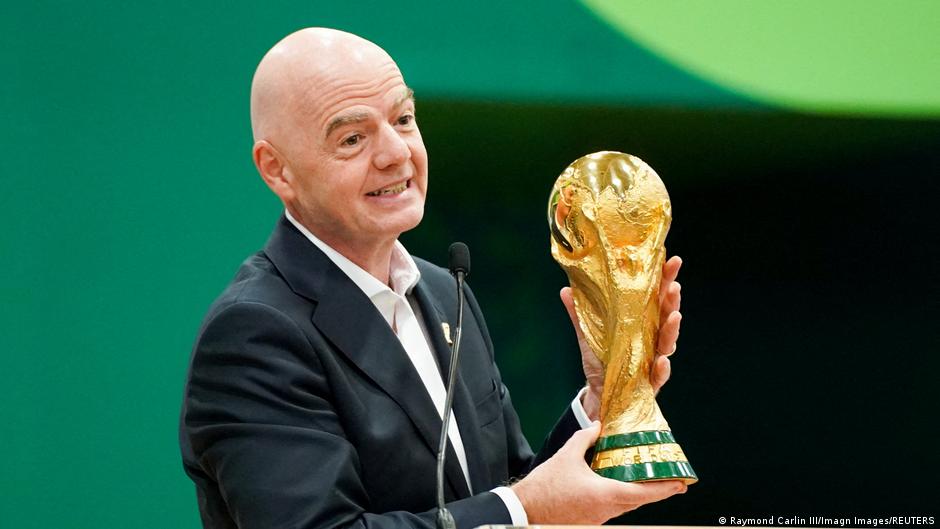


Two weeks after what was considered a successful World Cup, FIFA is drawing the wrong kind of headlines.
FIFA president Gianni Infantino's proposal to sell stakes in the World Cup through private investment is dead. In a statement late Friday, Infantino said he "listened carefully to all the views, it has become clear that the project has created divisions of a nature that, regardless of the level of support, are no longer in the interest of the objective set out in the first place."
"Moving forward, my intent is to bring all interested parties back together in the coming days and weeks in the spirit of shared interest in our game, and with the objective to continue growing football everywhere, particularly in those countries that mostly need our support," Infantino added in his statement.
The backlash to Infantino's idea started immediately with confederations, including UEFA, which governs European soccer, criticizing the plan and threatening to boycott future competitions.
Here's a rundown of Infantino's original idea, how it all fell apart, and what might come next.
What was Infantino's plan?
Infantino, who has been in charge of FIFA since 2016, wanted to sell stakes in the World Cup to private investors, including Joshua Kushner, the brother of U.S. President Donald Trump's son-in-law Jared Kushner. The transaction would have been done through Thrive Capital, a venture-capital firm.
Had the plan be approved — and Infantino only needed 106 of the 211 member associations to agree with it to move forward — a company known as FIFA Forward Enterprise would have taken control of selling media rights, sponsorships and tickets for the top men's and women's competitions, including World Cups. FIFA would focus on governing the game itself while maintaining an 80% share, with the Thrive group shelling out $4.2 billion for its 20% stake.
From all this, Infantino would have reportedly stood to gain tens of millions of dollars.
How would member associations have benefited?
Each of FIFA's 211 member associations would have been guaranteed a one-time payment of $20 million — up from its regular $8 million payout via the FIFA Forward Program — by green-lighting Infantino's idea. By 2038, another $66 million via three separate payments would have been paid out.
FIFA had set a Sept. 19 deadline for member associations to make a decision.
"We want to generate more revenues, and we have to generate more revenues, because in the vast majority of the world, in 80% of the world, if we don't invest, if we don't believe ... nobody will," Infantino had told member associations a day before the 2026 World Cup Final. If not, "the concentration will always go to a few, big [countries], and we will remain as we are."
Isn't FIFA a non-profit organization?
Based in Switzerland, FIFA is a non-profit association, which means they are not taxed like regular companies. While money generated is reinvested into developing the sport around the world, FIFA reportedly has about $4 billion in reserves.
FIFA has said it expects to bring in $15 billion in revenue from the 2023-26 World Cup cycle.
What role would Infantino have had if this plan was approved?
Infantino was reportedly set to take on a commissioner-like role at the end of his next FIFA presidential term in 2031. (He has claimed he has the support of "more than 200" member associations when he runs for re-election in 2027.) He would have then been granted a salary bump which would have seen him take in as much as NFL commissioner Roger Goodell, who makes about $60 million a year.
Infantino currently makes a basic annual salary of around $3.3 million. He received a 33% bonus increase ($2.78 million) in 2025.
How did this idea go over around the world?
UEFA and Concacaf quickly released statements vehemently rejecting the plan. The 55-nation European association was so against the idea that it announced a boycott of all FIFA-led competitions until the proposal was permanently tabled.
(Reminder: 11 UEFA teams will qualify for next summer's women's World Cup in Brazil, and Portugal and Spain will be among the co-hosts for the 2030 men's World Cup.)
In a statement, FIFA said that it "respects the feedback and concern aired in public" before blaming media for incorrectly reporting details without providing any examples of incorrectly reported details.
UEFA and Concacaf's beefs involved the lack of transparency. The former said the idea was "conceived in secret and brought to the brink of approval without any meaningful consultation with those entrusted with stewarding the game," while the latter said its membership "expressed deep concerns about the lack of due process surrounding the proposal, the artificially short deadline imposed, and the absence of any review or approval by the relevant FIFA governance bodies."
The Confederation of North, Central American and Caribbean Association Football and the Asian Football Confederation (AFC) also expressed their opposition.
FIFA's response was to express disappointment that the proposal leaked. FIFA decided to put the decision on all member associations, saying they should all "have the opportunity to take meaningful ownership of the commercial opportunity of football in their respective countries."
Additionally, FIFA made sure to declare: "Nobody is selling football. This is not something FIFA would ever entertain."
The fallout continued on Friday as Carlos Cordeiro, one of Infantino's top advisers at FIFA and former U.S. Soccer president, resigned from his position over the proposal.
In a scathing statement that made clear he was strongly opposed to the idea of selling stakes in the event, Cordeiro said he had no involvement in the plan and called on the member associations to reject it.
FIFA's chief operating officer Kevin Lamour told the Associated Press that staff were "deceived" by Infantino's lack of transparency.
"It is the project of one person," said Lamour, who was appointed in 2024. "Not only must this project not go ahead … but the time has now come for football political leaders to ask themselves the right questions and make the right decisions. … And if that means I lose my job then so be it. I will understand and respect that decision. At least I'll sleep well tonight."
Will the 2030 World Cup include 64 teams?
That's another issue that's been raised and has faced significant backlash. The 2026 World Cup was the first men's tournament to feature 48 teams, up from 32 in 2022. More teams equals more money being generated, especially with the majority of matches this summer having taken place in the United States.
CONMEBOL, which runs South American soccer, proposed the idea in 2025 with 2030 being the centennial edition of the World Cup and Argentina, Paraguay and Uruguay among the co-hosts. FIFA has begun studying the impact of adding another 16 teams in four year's time and if it would have any negative effects on the global calendar, event operations and dilution of interest.
Could Infantino's standing be negatively affected by all of this?
UEFA announced on Saturday that Infantino has "lost the confidence" of the European confederation. Happy that the proposal has been dropped, UEFA believes the soccer world has lost trust in the FIFA leader.
"We cannot keep going on like this with secret schemes on fast track timescales, cooked up by faceless individuals and of dubious benefit to the game. We must identify those responsible and hold them to account," UEFA said in a statement. "It is right that, in the coming days and weeks, UEFA will work with its associations and in close co-operation with other confederations to reflect on how this happened and devise a plan to make sure that it cannot occur again.
"That review should be thorough and fundamental. No option should be off the table. The current FIFA leadership has not only lost UEFA's confidence but also that of many other members of the football family."
"On both these promises, he has failed to deliver. The shabby, back room, opaque deal he hatched and tried to force through was anything but transparent," the statement added.
UEFA also called for a "robust review of FIFA's leadership and governance" and the AFC wants an "urgent review" of the decision-making process of soccer's governing body.
"This is not the first occasion where major stakeholders have been confronted with significant initiatives after the direction of travel appears to have already been determined," the AFC statement said.
Could Infantino be removed?
That is potentially in the works.
The removal process would require 43 member associations to trigger a no confidence vote against the FIFA president. But any opposition would require an alternative choice to take over. Infantino is up for re-election in March 2027 for his final four-year term, and even before all of this, no candidate had stepped forward to take him on.
A deadline of Nov. 18 is set for anyone to announce their candidacy. But the groundswell of opposition to his plan, plus the sour reaction to 64-team World Cup idea, looks like it will spur support in a different direction.
Of course, while there is the negative noise currently surrounding FIFA and Infantino, he has his allies around the world. But the wave of criticism is growing and massive changes could be coming to FIFA in the coming months.
Source: Yahoo Entertainment